Drivers keep hitting Waymos and taking off, police records show
Waymos were involved in police-reported hit-and-runs at 2.4 times the rate of other Maricopa County drivers.
PHOENIX(InvestigateTV) — Waymo’s own roadside assistance crews have been telling police about a surprising pattern: drivers who crash into the company’s robotaxis frequently take off.
“It’s quite shocking how many people just take off,” a Waymo roadside assistance specialist told a Phoenix police officer.
An investigative analysis of more than four years of police records backs that up.
Nearly half of the Waymo crashes reported to police in metro Phoenix were hit-and-runs. Accounting for miles driven, Waymos were involved in police-reported hit-and-runs at 2.4 times the rate of drivers in Maricopa County.
Waymo reviewed the methodology and said its researchers “appreciated the rigor and thought” behind it. But the company argues it is impossible to determine whether its vehicles are actually involved in more hit-and-runs, or whether Waymo simply reports the incidents to police more consistently than the general public.
‘They just leave’
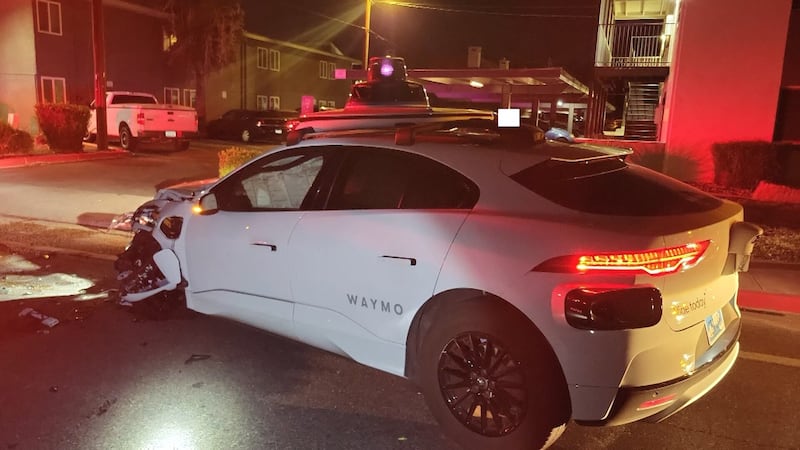
Body camera footage from March 2024 shows Chandler Officer Seth Chavez responding to a crash near Ray and Price roads where someone hit the back of a driverless Waymo and drove away. Chavez told the roadside specialist waiting at the scene that he’d never handled a call quite like it.
“People rear-end these things all the time,” the specialist responded. “Most of the time, they just leave.”
Months later, in October 2024, a truck damaged a Waymo near Buckeye Road and 2nd Street in Phoenix and drove off. Another Waymo roadside specialist let the responding Phoenix officer in on the same secret.
“I don’t know how many of these reports you do, but I’m surprised at how many hit-and-runs we honestly get, and where it’s a good amount of damage,” the Waymo specialist said. “Like, do you not realize there’s cameras on these?”
43 of 88 crashes
Arizona’s Family Investigates spent 10 months collecting police crash reports and body camera footage from the five cities in Waymo’s Valley service area: Phoenix, Scottsdale, Chandler, Mesa and Tempe.
There were 88 police-reported crashes involving Waymo vehicles from Sept. 1, 2020, through Dec. 31, 2024. Of those collisions, 43, or 49%, were classified as hit-and-runs in which the Waymo stayed and the other driver left. In most cases, the damage was minor.
To compare the rate of those crashes with human drivers, Arizona’s Family worked with a traffic safety researcher to calculate hit-and-run rates per million miles driven for Waymo and for the general public in Maricopa County.
Waymo: ‘The standard today is not perfection’
Camille Dredge, Waymo’s senior director for ride-hail operations, spoke with Arizona’s Family in 2025.
“The standard today is not perfection,” Dredge said. “Collisions will and can occur. We are absolutely prepared to respond to them.”
Waymo declined a request for a new interview about the findings, providing written responses instead.
In a statement, Waymo said the safety of riders and communities is its “absolute priority.” The company said that across more than 90 million fully autonomous miles in Phoenix, its vehicles cut crashes involving serious injuries or worse by 90% compared with human drivers.
Waymo said hit-and-runs are uncommon relative to the more than 4 million autonomous miles its vehicles drive each week across more than 15 U.S. cities. The company did not say whether it tracks hit-and-runs internally or how many it has recorded.
Dredge did not offer a theory for the hit-and-runs. In a few cases, the reason seems apparent. In a 2020 Mesa crash, among the earliest in the records, officers suspected the driver who hit a Waymo was impaired.
“You’re real loopy,” an officer told him on body camera video. “Your speech is slurred.”
Most police reports, however, offer no clue about why drivers leave.
Experts point to confusion, sudden braking
Missy Cummings, a George Mason University professor, and Phil Koopman, a professor emeritus at Carnegie Mellon University, are two leading researchers on autonomous vehicles.
“We researchers and the government need to do more to try to figure out what is going on with this and how to mitigate it,” Cummings said.
They offered two possible explanations for why drivers leave. The first is that drivers are confused about how to exchange information with an autonomous vehicle.
“I’ve noticed that police have trouble interacting with these vehicles. Emergency responders have trouble interacting with these vehicles. They’re not sure what to do,” Koopman said. “Ordinary drivers don’t go through how-to-talk-to-a-robotaxi training.”
“If there’s no one there to trade insurance cards with, then what do you do?” Cummings said.
A 2022 Chandler police report illustrates the problem. After a minor crash in a 7-Eleven parking lot near Warner and Dobson roads, the at-fault driver walked up to the Waymo with her “driver’s license and vehicle registration in hand,” according to the report. But the vehicle was driverless, and with no one to give her information to, the woman left.
Waymo said it invests heavily in educating drivers on how to exchange insurance information. Once drivers submit their information through one of its digital options, the company said, they don’t need to wait at the scene.
The second theory Cummings and Koopman offered is that Waymos may be prone to a type of crash that gives human drivers an incentive to flee.
“I’ve done an analysis on the publicly available data, and Waymos get hit from behind two times more than your average human driver does,” Cummings said.
She pointed to what researchers call phantom braking, when an autonomous vehicle stops suddenly for something that isn’t there.
“Everyone hears about hallucinations with generative AI. These are real hallucinations,” Cummings said. “The cars see something that isn’t there. And the car’s response is to do an emergency braking because, to them, it appears that something is there.”
“If they’re not sure, the safe thing, tactically, is to stop,” Koopman said. “But what you have to take into account is that following drivers, if there’s no reason to brake, they’re not expecting it.”
Waymo disputes that sudden braking is a significant factor. The company said rear-end crashes are the most common type of crash for both human and autonomous drivers. It said that over 270 million autonomous miles, Waymos were involved in 41% fewer rear-end crashes causing airbag deployment than human drivers in its cities.
A peer-reviewed analysis by Waymo found its vehicles were fully stopped in 72% of rear-end crashes that deployed airbags and 20% of those causing injuries. The company said the analysis found its vehicles were not hard braking in any of the airbag crashes or in 75% of the injury crashes.
‘It should be on the robotaxi companies’
Some drivers do wait for Waymo’s roadside team and exchange information. Arizona law requires drivers who hit an unattended vehicle to locate the owner or leave their contact information.
Both Cummings and Koopman said Waymo should make the information exchange easier.
“If robotaxi companies are putting vehicles on public roads that interact with other people, it should be on the robotaxi companies to figure out how to make that interaction happen,” Koopman said.
Waymo said drivers do not need to wait for a company representative to arrive at the scene.
People involved in a crash with a Waymo can:
- scan the QR code on the driver’s side door
- contact Waymo through its app
- fill out a form at Waymo.com/notify
- call 844-263-9885
- email insurance@waymo.com
- speak with a roadside assistance representative, if one is at the scene
Copyright 2026 Gray Media Group, Inc. All Rights Reserved.